
Mainstream CBD | Lakeville, MN
At the Lakeville counter, one of the most common questions we get is: "Is THCA the same as delta-9?" Short answer: they're related, but they're not the same. And with federal hemp rules shifting on December 11, 2026, understanding the difference matters more than ever.
This is a plain-English follow-up to our guide on how to read a COA. We'll cover what each compound is, how heat turns THCA into delta-9, how formats differ, and what the December 11 total-THC standard actually changes.
What is delta-9 THC?
Delta-9 THC (delta-9-tetrahydrocannabinol) is the main intoxicating compound people usually mean when they say "THC." It's already active. In flower and concentrates you'll often see it listed next to THCA on a lab report. In edibles, drinks and shots, what's on the label is typically delta-9 that your body can feel without you lighting anything.
Under the current federal hemp standard that still applies today, hemp is judged mainly on delta-9 THC at or below 0.3% on a dry-weight basis (the 2018 Farm Bill style definition). That's why so many "hemp-derived" products are marketed around that delta-9 number.
What is THCA?
THCA (tetrahydrocannabinolic acid) is the raw, acidic form of THC found in the plant and in cured flower and concentrates that haven't been fully decarboxylated. On its own, THCA is generally considered non-intoxicating.
Heat is the switch. When you smoke, vape or dab a THCA-rich product, THCA converts into delta-9 THC. That's why THCA flower, pre-rolls, diamonds and many carts feel intoxicating once you use them with heat, even if the delta-9 line on the COA looks low.
How heat converts THCA into delta-9 (and the total THC formula)
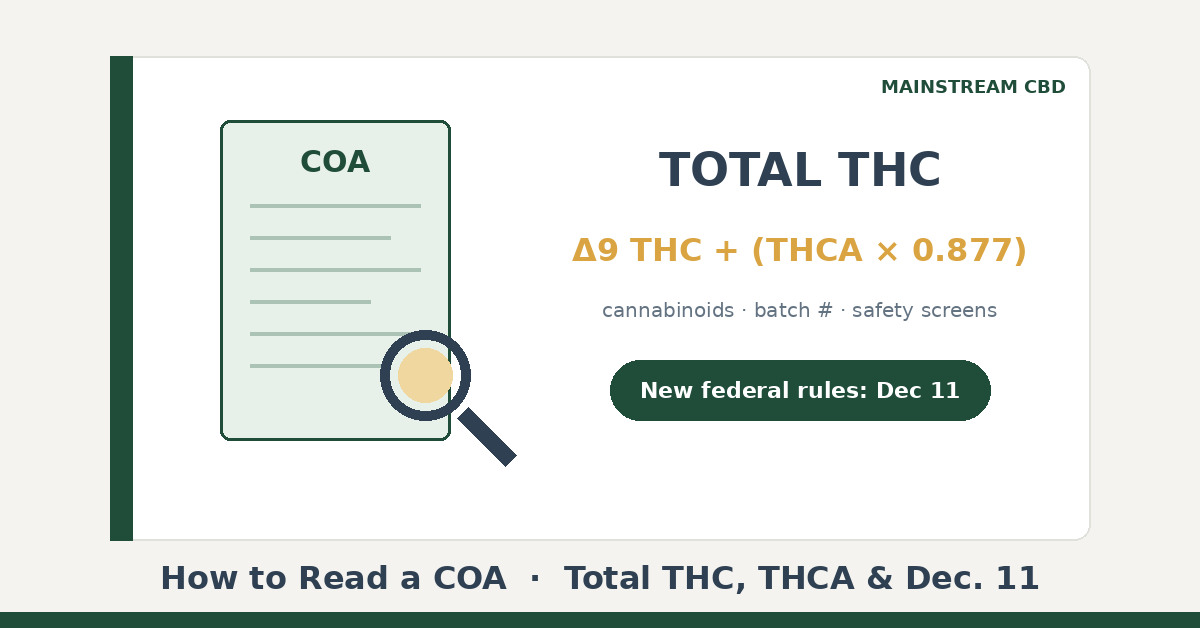
Labs usually report both delta-9 and THCA, then calculate a Total THC line:
Total THC = Delta-9 THC + (THCA × 0.877)
The 0.877 accounts for weight lost when the acid form converts to delta-9. A flower with very little delta-9 and a high THCA percentage can still have high total THC. That's why December 11 is such a big deal for THCA products: the new federal definition looks at total THC, not delta-9 alone.
For practice reading those lines, see How to Read a COA.
How products differ by format
In practice, THCA vs delta-9 often comes down to how you use the product:
- THCA-forward formats: flower, pre-rolls, diamonds/dabs, many live resin or live terpene carts and disposables. These are meant to be heated. Effects usually come from THCA converting to delta-9 during use.
- Delta-9-forward formats: gummies, sparkling drinks, shots and some labeled delta-9 carts. Edibles and drinks don't need a lighter; check the COA for the full profile.
Neither category is "better" in the abstract. It depends on whether you want something you smoke or vape, or something you eat or drink, plus strain, dose and preference.
What December 11, 2026 changes
Congress redefined hemp in Public Law 119-37. Most of that change was delayed from November 12 to December 11, 2026 through the continuing resolution path (H.R. 6500 / related funding extension). Here's the timeline we share at the counter:
- Until December 11, 2026: The current federal hemp standard focused on ≤0.3% delta-9 THC still applies for the main definition questions here.
- November 12, 2026: Cannabinoids a cannabis plant can't naturally produce (often discussed as synthetic / non-naturally-produced cannabinoids) lose federal hemp status.
- December 11, 2026: Total THC includes THCA. Plant material must meet ≤0.3% total THC. Finished hemp-derived cannabinoid products face a cap of 0.4 mg total THC per container.
One soft local note: Minnesota's LPHE (low-potency hemp edible) rules do not automatically flip on December 11. A product can still be state-legal under Minnesota LPHE while falling outside the new federal hemp definition, which can raise banking and interstate questions. This isn't legal advice. For the fuller federal picture, see our Federal Hemp Ban 2026 Update.
Side-by-side: THCA products we have in stock
These are heat-activated formats. Always check the product page COA for that batch's delta-9, THCA and total THC.

St Croix Cannabis 99.9% Pure THCA Diamonds 1 Gram — Classic dab format. High-THCA concentrates are one of the clearest examples of why total THC math matters on a COA.

Habit THCA Live Terpene Cartridge | 1g 510-Thread — A 510 cart for a THCA vape with live terpene flavor. Heat from the battery drives conversion.

Habit 2g THCA Rechargeable Disposable | 2000mg — All-in-one disposable. Same THCA story as carts: designed to be heated when you hit it.

Habit THCA Pre-Rolls | 1.5g (2×0.75g) — Pre-rolls make the conversion obvious: lighting the joint turns THCA into delta-9 as you smoke.

Coast THCa Liquid Diamond Live Resin Disposable | 2g — Disposable that pairs THCA with a live resin style profile. Check the COA for that batch's total THC line.
Side-by-side: delta-9 products we have in stock
These lean on delta-9 as the labeled intoxicating cannabinoid. Edibles and drinks don't need heat the way flower and dabs do.

St. Croix Cannabis 1g Delta 9 Live Resin Vape Cartridge – 510 Thread — A delta-9 live resin cart for people who want that format labeled around delta-9 rather than THCA.

Habit Delta-9 Live Rosin Gummies 5mg | Strain-Specific — A measured edible serving. No lighter required; read the COA for mg per serving and per package.

Habit Sparkling Delta-9 Drinks | 100mg THC Seltzers — Sparkling delta-9 drinks. The per-container math on a COA is what ties this format to the December 11 conversation.
FAQ
Is THCA legal hemp right now?
Under the current federal standard that still applies before December 11, 2026, hemp compliance is focused on delta-9 THC (≤0.3%). Many THCA products are sold as hemp-derived under that framework. The December 11 total-THC standard changes the federal math. State rules vary.
Will smoking THCA get me high?
THCA itself is generally described as non-intoxicating. Heating it (smoking, vaping, dabbing) converts it to delta-9 THC, which is intoxicating. Heated THCA products and delta-9 edibles can both produce effects, through different paths.
Why does total THC use 0.877?
When THCA converts to delta-9, it loses a little mass. The 0.877 factor estimates the delta-9 that can form from the THCA present. Labs use it on the Total THC line of a COA.
Do Minnesota LPHE rules change automatically on December 11?
No. Minnesota's low-potency hemp edible framework is state law and does not automatically rewrite itself when the federal hemp definition updates. A product can be state-legal under LPHE and still be out of step with the new federal definition after December 11, which can matter for banking and interstate issues. Ask us in store if you want help with a specific label and COA.
Should I buy THCA or delta-9?
Flower, pre-rolls, diamonds and many vapes are usually the THCA side. Gummies and drinks are usually labeled delta-9. Taste, dose and format matter more than the buzzword. We'll help you match it at the counter.
Where can I learn more about the federal timeline?
Read our Federal Hemp Ban 2026 Update and how to read a COA. Congress could still adjust dates before December 11; we update this blog when something material changes.
Questions? Come see us in Lakeville
Want help comparing a THCA cart to a delta-9 gummy, or walking through a lab report? Visit Mainstream CBD in Lakeville, MN at 17677 Kenwood Trl. Or shop anytime at mainstreamcbd.com. Some items may be online-only, and in-store selection can differ, so check the product page or ask us before you drive over.
All products are intended for adults 21+ only. These statements have not been evaluated by the Food and Drug Administration. Products are not intended to diagnose, treat, cure, or prevent any disease. This post is for educational purposes only and is not legal advice. Hemp and cannabis laws vary by state and can change, so please check your local laws before purchasing.